
Call Center Compliance: An Enterprise Guide and Practical Checklist
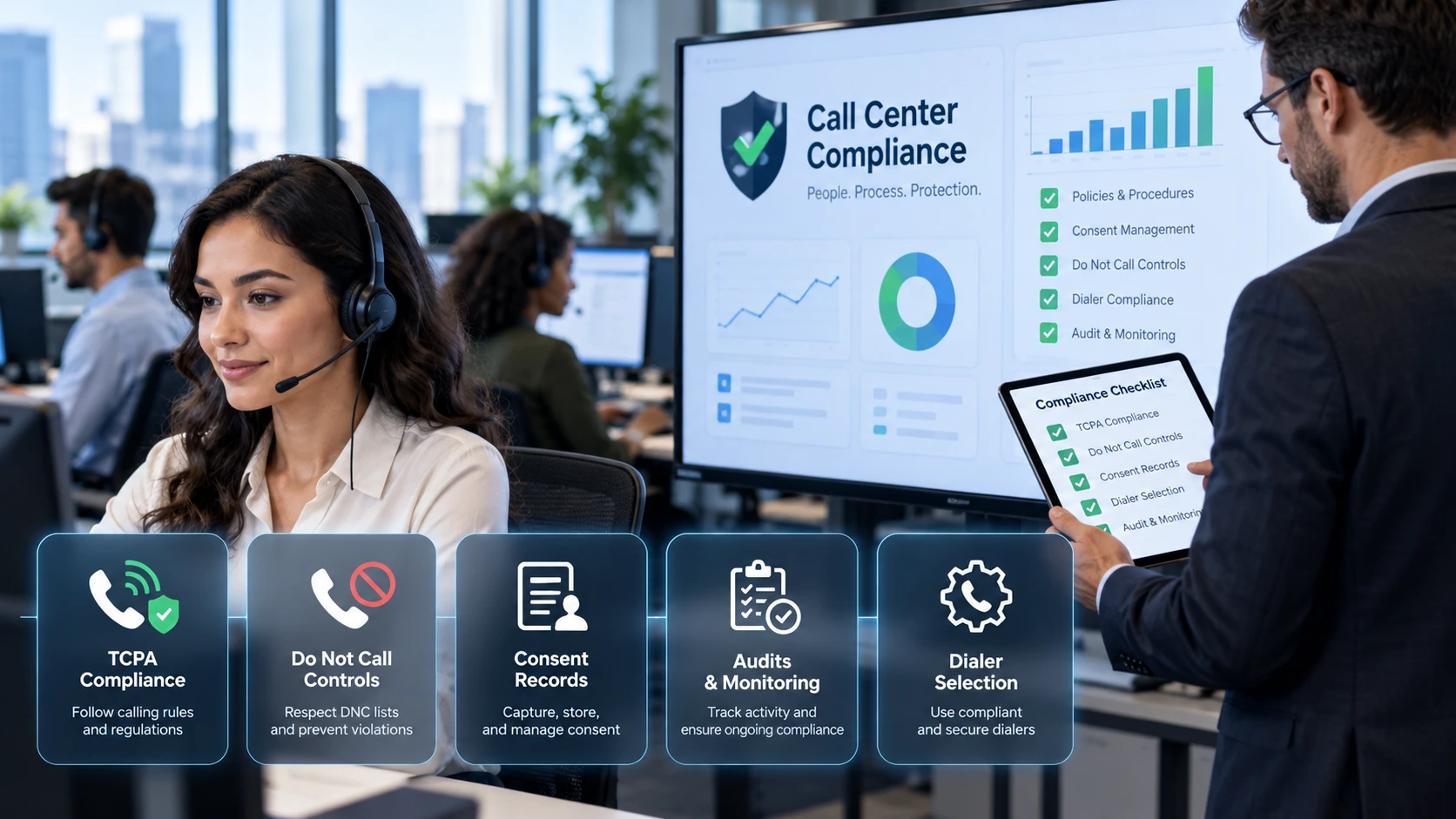
Call center compliance is a daily operating requirement, not a policy to review once a year. For enterprise outbound teams, a single campaign can involve multiple business units, agencies, data sources, and dialing workflows. That complexity makes it harder to confirm whether each contact is eligible to receive a call and to demonstrate what happened later.
A practical compliance program connects legal guidance to the systems agents actually use: lead intake, consent documentation, suppression lists, call scheduling, dialing, quality assurance, and reporting. This guide explains the controls to review, the questions to ask a technology vendor, and a checklist operations leaders can use with their legal teams.
What call center regulatory compliance covers
In the United States, outbound operations may be affected by the Telephone Consumer Protection Act (TCPA), the FTC Telemarketing Sales Rule (TSR), state telemarketing laws, privacy requirements, and industry-specific rules. Which requirements apply depends on the type of call, recipient, technology, purpose, jurisdiction, and any exemptions. A B2B calling process should not be assumed to follow every rule that applies to consumer telemarketing.
A sound operating model separates three questions: Is this contact eligible to be called? Is this particular campaign and dialing method permitted? Can the business produce records that support its decision? Technology can help operationalize answers, but does not replace legal analysis.
TCPA compliance for call center campaigns
For a TCPA compliance call center workflow, review the consent requirements for each planned calling method, especially calls using artificial or prerecorded voice and technologies regulated under applicable law. Avoid treating a purchased lead list or a CRM opt-in field as sufficient proof without checking what the person actually agreed to.
Useful evidence can include the consent language shown to the consumer, its timestamp, the telephone number, the seller identified, the collection source, any later opt-out, and the version of the campaign rules in effect when the call was made. Different call types and jurisdictions can have different standards, so legal counsel should confirm the rule set.
Explore how a TCPA compliant dialer (/tcpa-compliant-dialer/) may fit a wider campaign-control workflow; assess the actual supported features and their configuration rather than assuming the product guarantees legal compliance.
Do Not Call, calling hours, and suppression rules
A reliable suppression process checks relevant National Do Not Call requirements, any company-specific do-not-call requests, contact preferences, and jurisdiction-specific restrictions. Under the FTC’s TSR safe-harbor framework, organizations relying on it must follow procedures that include regularly updating the National Registry data; the FTC describes a 31-day limit for the registry version used in screening.
Call-time controls should consider the recipient’s local time zone, not simply the agent’s location. Provide staff with a clear procedure for capturing a do-not-call request immediately and propagating that status across active campaigns and connected systems.
Teams with highly regulated calling workflows should evaluate a dialer for compliance teams (/dialer-for-compliance-teams/) alongside written procedures, training, and audit processes.
Call recording, data handling, and audit trails
Call recording rules vary across jurisdictions, so consent notices and recording settings require separate review. Store sensitive recordings with role-based access, retention schedules, and documented deletion procedures. The audit trail should show campaign settings, suppression outcomes, user changes, call dispositions, and relevant exceptions.
A well-structured call center reporting and analytics (/call-center-reporting-analytics/) workflow helps managers review patterns and investigate exceptions without relying only on manual spreadsheets.
Call center compliance checklist
Use this call center compliance checklist before launching a campaign and again whenever the list source, dialing method, target states, or vendor settings change:
- Confirm which federal and state rules apply to the campaign and call type.
-
Document the source, wording, timestamp, and scope of applicable consent.
-
Screen contacts against applicable Do Not Call and internal suppression records.
-
Apply the correct permitted calling windows and time-zone logic.
-
Define opt-out handling and ensure suppression changes reach every dialer and CRM.
-
Review call recording notices, access permissions, and retention requirements.
-
Test dialing configuration, including abandonment controls where applicable.
-
Train agents and vendors, assign owners, and record policy exceptions.
-
Audit sample calls and retain the records needed to explain campaign decisions.
How to assess call center compliance software
When evaluating call center compliance software, ask for a demonstration of the specific controls your organization needs. Useful evaluation areas include suppression-list synchronization, configurable dialing windows, permission controls, call history, consent-data integration, and downloadable audit records. Confirm whether controls are native, configurable, or dependent on external tools.
If multiple departments share campaigns or contact pools, compare enterprise dialer software (/enterprise-dialer-software/) against your operational governance requirements, not just maximum dialing capacity.
Compliance considerations for enterprise platforms
An enterprise deployment needs consistent controls across teams. Define who can import lists, approve campaigns, change calling windows, override restrictions, export call records, and review exceptions. Platform selection should account for governance, integration, and the ability to test controls before go-live.
Frequently asked questions
What is call center compliance?
It is the combination of legal obligations, operating procedures, staff training, and technology controls used to conduct calling activities lawfully and document those activities.
Can a dialer make a call center TCPA compliant?
No software automatically guarantees compliance. A dialer can support restrictions and recordkeeping, but eligibility, consent, configuration, vendor behavior, and legal interpretation still matter.
How often should compliance controls be reviewed?
Review them before new campaigns, after regulatory or workflow changes, and through scheduled audits. The appropriate frequency depends on the organization’s risks and obligations.